Science Meets Energy Healing
For decades, energy healing has largely been studied for its ability to reduce stress, anxiety, pain, and improve quality of life. Now, researchers at one of the world's leading cancer centers are beginning to investigate whether biofield therapies may also influence biological processes in cancer cells themselves. The findings are early—but they are worthy of thoughtful attention.

As a Reiki practitioner, I have witnessed more than my share of moments that are difficult to explain.
A client sleeps deeply after weeks of insomnia
A client becomes pregnant after years of struggling with infertility.
Someone living with chronic pain finds relief
An anxious mind becomes peaceful
These experiences are deeply meaningful—but personal experiences alone are not scientific evidence. They are observations that deserve compassion and curiosity, but they are not the same as controlled scientific research.
Recently, scientists at The University of Texas MD Anderson Cancer Center, one of the world's leading cancer research institutions, published one of the most comprehensive pre-clinical investigations to date exploring whether biofield therapy—the broader scientific term that includes energy healing practices such as Reiki, Therapeutic Touch, Healing Touch, Qigong, and similar approaches—might influence pancreatic cancer biology.
Published in the peer-reviewed journal Cancer Medicine, researchers led by Dr. Lorenzo Cohen spent four years investigating biofield therapy in pancreatic cancer—one of the most aggressive and difficult-to-treat cancers. Their work was not conducted on people but in carefully controlled laboratory experiments using pancreatic cancer cells, patient-derived organoids, and mouse models.
Why begin in the laboratory? Because laboratory models eliminate one of the biggest questions surrounding complementary therapies: placebo effects.
Cancer cells in a petri dish do not know they are being "treated." Mice do not expect to feel better because someone believes in energy healing.
The researchers wanted to know one thing: Can biofield therapy produce measurable biological changes independent of human belief or expectation?
Across multiple experiments, the researchers observed measurable biological changes following exposure to biofield therapy:
slowed the growth of pancreatic cancer cells
reduced the ability of cancer cells to invade surrounding tissue
altered cellular electrical properties
affected mitochondrial structure and function
changed the activity of genes involved in cell division, including FOXM1
reduced liver metastasis in mouse models by more than 50% in repeated experiments.
This is significant because the study did not rely on personal perception, relaxation, or expectation. Instead, it examined whether living cells and animal models demonstrated measurable biological changes after exposure to biofield therapy.
In the mouse models liver metastasis was reduced by more than 50% and while this is very exciting, this finding will require confirmation in human clinical trials before any conclusions about patient treatment can be made.
At the same time, it is important to be clear and grounded. This was preclinical research, not a human clinical trial. It does not show that Reiki or biofield therapy cures cancer, treats cancer, or should replace medical care. More research is needed before we can understand what these findings may mean for people living with cancer.
For those of us who practice Reiki, this kind of research is exciting not because it “proves everything,” but because it opens a door. It suggests that subtle, non-invasive healing practices may interact with biological systems in ways science is still learning how to measure.
For decades, energy healing has been discussed in terms of personal experience. People describe feeling calmer and less anxious, sleeping better, feeling less pain, and experiencing greater peace during difficult medical treatments.
These experiences are valuable, but they are also subjective. This study asked an entirely different question. Instead of asking people how they felt, researchers asked whether living cells themselves behaved differently after exposure to biofield therapy. That is an exciting shift in the scientific conversation.
As a Reiki practitioner, I find this research deeply encouraging—not because it proves Reiki heals cancer, but because respected scientists are willing to investigate questions that many once dismissed without examination.
How might it happen?
What biological pathways are involved?
Can these findings be reproduced?
At The Reiki Sanctuary, Reiki is offered as a complementary practice — a gentle support for relaxation, nervous system calming, emotional steadiness, and whole-person care. I view Reiki as one of the tools in our toolbox to support energetic, physical and mental wellbeing. Reiki is part of a widening circle of support: one that honors the body, mind, spirit, and the deep human need to feel held during times of uncertainty.
This new research does not change that philosophy. Instead, it invites curiosity.
It reminds us that science is continually evolving. History is filled with discoveries that were once thought impossible simply because we lacked the tools to observe them. Perhaps we are witnessing the beginning of a new chapter—one in which modern research and ancient healing traditions begin speaking a common language.
What do I think? I do what I do, and I see what I see. Again and again, I witness moments that are difficult to explain—moments of profound relaxation, unexpected shifts, deep peace, and sometimes outcomes that leave everyone involved quietly amazed. I am deeply grateful for this healing practice and for the privilege of sitting beside those who seek healing in all its forms. I don't feel compelled to explain every experience or fully understand every mystery. My role is simply to provide radical presence, offer Reiki with integrity, and trust that each person receives exactly what they need in that moment.
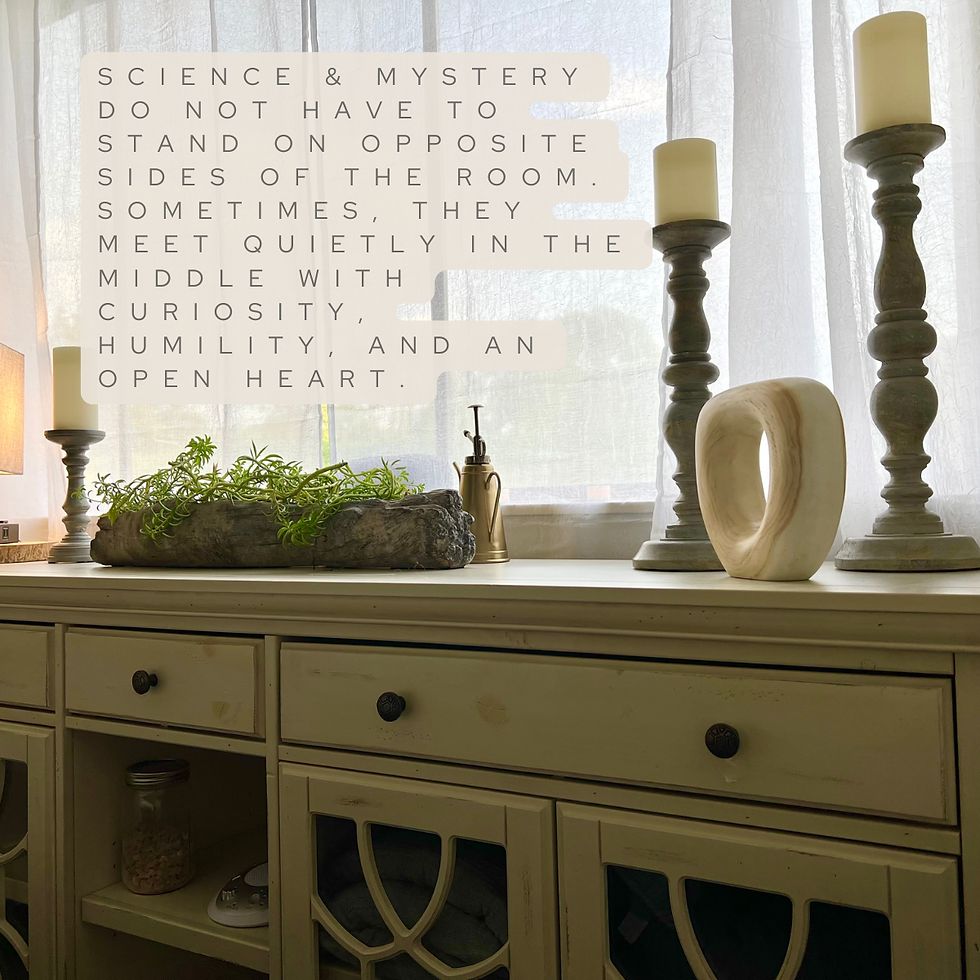
We can honor ancient wisdom while welcoming rigorous science. Science and mystery do not have to stand on opposite sides of the room. Sometimes, they meet quietly in the middle — with curiosity, humility, and an open heart.
Sources:
The Preclinical Effects and Mechanisms of Biofield Therapy on Pancreatic Cancer Cell Growth and Metastasis Published in Cancer Medicine (April 2026); 🔗 Read the full study on Wiley Online Library; DOI: 10.1002/cam4.71726
MD Anderson's Publication Page
This is the university's research repository with the abstract and citation information. 🔗 MD Anderson publication page
PubMed


Comments